

Disruption. It’s as fitting as any word to denote what has happened in 2020. Perhaps never in human history have the plans of so many been disturbed and interrupted. While life never quite goes the way we thought it would, this has been the year that no one expected. The COVID-19 pandemic has thrown our world into disarray. How should we understand what has come upon us?
If we want to discover the work of God in human affairs, we could do worse than to look at all the ways they are disrupted, both at an individual and macrocosmic level. What we find in the Bible is that God is not just with us in the midst of our disturbances; he is often the source of them. When it comes to human experience, God is the disrupter par excellence. Nothing was more disruptive to the world than the coming of the carpenter from Nazareth. Death itself was dealt a death blow on the cross; Christ’s sacrifice was the disruption of humanity’s appointment with total doom. And while the cross is the highest expression of God’s disruptive hand in human affairs, it is by no means the only one. We would do well to ask the Jordan River about the time he cut off her flow of water, making her pause in one restrained heap at the city of Adam; or to ask the Sun about the day he was frozen from his daily course at Joshua’s injunction; these can testify to us firsthand. We could hear Nebuchadnezzar’s testimony as well, when the watcher issued the decree of the holy ones concerning his derangement and suspension as ruler over Babylon, or the testimony of Sodom’s citizens’ sudden (and permanent) disruption of their day to day lives. Truth be told, time would fail us were we to adequately chronicle the ways Yahweh works disruption in the earth.
This perspective is the one we must carry over when seeking to ponder and address what has been one of the most dramatic and pervasive disruptions to our lives in recent memory: the global and rapid spread of COVID-19. Has anything so thoroughly and quickly upended the routines of countless people? The regular rhythms of life scarcely reflected upon—morning commutes, happy hour with the coworkers, leg day at the gym—halted. Our seminal human events—weddings, baby showers, (let us not forget the millennial addition of gender reveals), birthdays and funerals—reduced to zoom calls or the sparsest of socially-distanced attendance. When the packed train cars languish of riders, the school desks sit empty, the ballparks stand famished of cheering fans, and the downtown avenues with their bistros, pubs and cafes are eerily subdued at evening, things have been disrupted indeed. To say nothing of the lives that have been tragically cut off by this plague. The question we must ask ourselves: where is God in all this?
God is Judge
We would do well to begin with this lately unpopular but biblical truth: plagues are something God has a history of sending our way ( Lev 26:26, Deut 28:58-61, 5 2 Sam 24:15, 2 Chron 21:15,18, Amos 4:10, Rev 15:1, 16:2). It is on his own list of prescribed judgments against nations; it is part of the mighty, fearful arsenal of his wrath. When plagues are deployed, the astute disciple of Christ is inclined to assume His judgments are in the earth. Why might God send a plague across the globe as judgment? The same reason he has sent plagues and other forms of his wrath to mankind throughout millennia: sin, wickedness, rebellion against God, the worship of other gods, or the denial of God altogether. The world is near filled to the brim with all of it1.
From the torture and labor camps inflicted upon the Uighur people by China, to the Islamic enslavement of women in Africa, to the systematic murder of unborn children in Europe and North America, we have given God no shortage of things to be incensed about, nor a shortage of reasons to compel him to intervene as a good, compassionate, and justice-loving God. Indeed, when one begins to truly ponder the incalculable amount of evil being wrought in the earth, it becomes astonishing that God has not already obliterated us entirely. This reveals the stupendous, merciful patience of the Father.
If God is good, then evil must be dealt with. Sin must be stopped. One way to do that is to destroy those committing sin, another way is to get those who are sinning to cease doing so, to turn from their wicked ways. God’s judgments have the utility of accomplishing both of these, by the destruction of some, and by provoking the repentance of others—as God in his sovereign wisdom portions out—so that sin is vanquished. Thus one chief reason God brings judgments to the earth and allows calamities to occur is so that men and women might repent. His heart is that none would perish, that mankind would be reconciled to His love through the blood of His son, in whom alone there is forgiveness of sins.
In this regard, God is like a parent who spanks their young child for repeatedly and blindly running out into the street, despite being told not to. The spank is hurtful, an action of discipline for an act of disobedience, but its impetus is not one of mere spite, but love for the child. It has the preservation of the child’s life as its end. God, who knows that sin will destroy us, does not let us dart freely into the street without his warning and reproof. He sends his judgments to reveal to us that we need him and that we are not okay. He uses them to teach us righteousness (Isaiah 26:9-10, Psalm 119:67, 71).
If there is one thing God is up to in this pandemic, it is the extending of this invitation to humanity to repent. Teeming masses need a restoration of right relationship with God. Is the Lord giddy over the misery and death COVID-19 has produced? Certainly not! But has this calamity been permitted by the decree of his mouth? Most definitely (Lamentations 3:33; 37-38). And in it all, a holy and merciful God is calling out to the inhabitants of the earth: Repent! You may not like your sporting events canceled, you may not like your businesses shut down, you may not like the loss of a loved one or an added threat to your own life, but far worse things than these will come upon you if you don’t turn and get right with me. Stiff medicine? Perhaps; though more unpleasant medicine could be given. But as stiff as the medicine may be, it is administered by the Great Physician—the most loving and skilled doctor of them all. He is disrupting our lives so that we might get right with him.
Disrupting the Narrative
There is also another reason why God sends his judgments into the world, and while it is not unrelated to the aforementioned ones, it is a reason worth drawing out into distinction, as this reason for judgment is particularly pertinent if we want to understand what God is doing in sending or allowing the spread of COVID-19. In studying the scriptures, we find the Lord’s judgments also come as refutations to a false and world-wide narrative that pervades humanity’s fallen existence. And the refuting of this narrative is certainly part of God’s plan for the pandemic.

“Forest Fire” by ArtofVisuals CC BY-NC-SA 2.0
In 2nd Peter 3, the apostle lets us in on a bit of last days rhetoric; the type of thinking that will pervade many minds, the sentiments that will be expressed from person to person. He tells us: “Know this first of all, that in the last days mockers will come with their mocking, following after their own lusts, and saying, ‘Where is the promise of His coming? For ever since the fathers fell asleep, all continues just as it was from the beginning of creation’” (2 Peter 3:3-4)*.
There is a story being pushed about our lives and the nature of our existence. This story is that life, in essence, is unchanging; what it is, is what it has always been, and what it has always been, is what it will always be. And notice what life is, in these mockers conception of it; it is conspicuously absent of one person in particular—God. Whatever continuity and rhythm life offers us, it is devoid of him. He is not active in it, and the idea that He would come and end it— that he would inject himself into the affairs of human history by his return, and bring about the consummation of the ages—is a laughable one.
But what does Peter says in response to this? Such scoffers, the apostle notes, have left out some very inconvenient facts from their narrative, facts that as it turns out, destroy all credence to their story. “For when they maintain this, it escapes their notice that by the word of God the heavens existed long ago and the earth was formed out of water and by water, through which the world at that time was destroyed, being flooded with water. But by His word the present heavens and earth are being reserved for fire, kept for the day of judgment and destruction of ungodly men” (2 Peter 3:5-7).
Human history is not one of lives lived and lost, devoid of God’s activity or intervention, with everyone going his or her own way, living as best befits their fancies or judgments; human history is one shaped by God’s creative and interfering hand. We are not alone; God is watching, and he is able to interject himself into all our doings. This, of course, is untenable for those who are set on “following after their lusts;” such realities must “escape their notice,” that is, be ignored and denied, so that the illusory basis for the chasing after of their lusts can go unhindered— sinning is so much more fun if God isn’t around. A godless world allows one to feel at ease with being godless. As wicked creatures, we are invested in the maintaining of this false narrative not just as a bulwark against the reality of God, but also against those who would assert an alternative narrative (and a true one at that) of God’s existence. The wicked must make sure those who assert such a narrative are scorned.
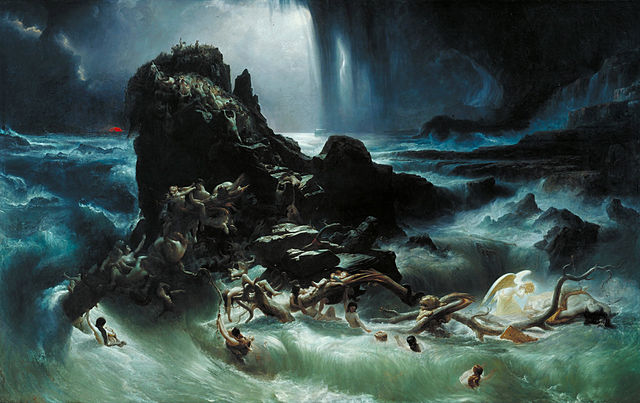
What throws a wrench in their false narrative? What rains on the world’s sunny, sin-indulgent parade of godlessness? What vindicates the righteous and their harangued assertions? Peter’s answer: the judgments of God. The flood, that premier ancient catastrophe, was the ultimate refutation of its time to the lie that God is not involved in our lives. God saw the wickedness of men, he was aware of every intent of the thoughts of their hearts, he noticed, and he decided to act—he disrupted their lives (Genesis 6:5-7).
Just as the parting of the Red Sea is often the emblematic example of God’s redemptive nature and saving power in the scriptures, one can say the flood, (along with the destruction of Sodom and Gomorrah), is emblematic of God’s wrathful nature and willingness to judge; it stands as a representative example of the myriad of calamities God has unleashed on the earth. What we must understand is that what holds true for the flood holds true for all his judgments; each time God releases a judgment on the world, each time he disrupts our lives, he is simultaneously disrupting the godless narrative we as humanity have conjured for ourselves—a conception of our existence that depends on his nonexistence, or else his absence and lack of intervention.
Notice too, the question posed by the mockers, on which their false narrative rests: “Where is the promise of His coming? For ever since the fathers fell asleep, all continues just as it was from the beginning of creation.” In other words: “That whole idea of Jesus coming back someday? Of ending the world as we know it and judging us for all our deeds? Doubtful. Ridiculous. Absurd. Silly. A fairytale—and a very nasty one at that. Nope,” the scoffers say, “no God is coming to judge us or stop us, everything is carrying on the way it has always been; we can live and do what we want.” The idea of final intervention is ridiculed and dismissed.
Hence, God’s disruptive judgments refute not just the godless narrative of a world without his involvement, they are disruptions which refute a narrative that denies the ultimate disruption; namely, the return of Jesus. Those chasing after their lusts, those indulging their sinful tendencies and loving it, loathe above all else the notion they might be stopped, or that their gaieties will be put to a forcible end. They detest too, the notion that their activities will be judged and, found unacceptable, that their souls will then be the recipients of divine, inescapable punishment. Having made the prince of the power of the air their king; they seethe at the idea of bending the knee to anyone else. But God is proclaiming to them through this pandemic as he has through other disruptions—you will. In our present crisis with COVID-19, God is once again taking aim at this false narrative and the denial of his second coming and the end of the world.
Average Day Apocalypse
It is no accident out of all the disruptive judgments from the Bible Peter could have picked, he chose that ruinous deluge. Jesus Himself likened the days of his return to that antediluvian period in the earth. In referencing the flood in his rebuttal to the mockers of Christ’s second coming, Peter no doubt was recalling the words Jesus himself spoke to him and his fellow apostles:
“For the coming of the Son of Man will be just like the days of Noah. For as in those days before the flood they were eating and drinking, marrying and giving in marriage, until the day that Noah entered the ark, and they did not understand until the flood came and took them all away; so will the coming of the Son of Man be. Then there will be two men in the field; one will be taken and one will be left. Two women will be grinding at the mill; one will be taken and one will be left. Therefore be on the alert, for you do not know which day your Lord is coming” (Matthew 24:37-42).
Much has been made of the seeming strangeness and unprecedented chaos that attends the period just before Christ’s return. Stars fall from the heavens (Mark 13:25), earthquakes and famines plague various places (Mark 13:8), locusts from the bottomless pit with scorpion-like tails torture men and women for five months (Revelation 9:5), and blood as high as the horse bridle flows for hundreds of miles (Revelation 14:20). But one fact that often seems overlooked in the Church’s collective consciousness concerning all things apocalyptic is the sheer normality of things preceding Christ’s return.
In Noah’s day, people were eating and drinking and getting married. In the days of Lot (the other man whose days Christ compares his return to) people were selling and buying, building and planting (Luke 17:28). The mundane and regular, the everyday routines and rituals of life—Jesus tells us such things will persist until the day of His return. What does a probable day of Jesus’ return look like? It looks like two women grinding at a mill, like two men working in a field, like the festive pour of wine at a wedding feast. In other words, it looks like construction workers setting beams high up on a new city sky rise, it looks like a teenager lazily scrolling on his phone as he sits on the bus, it looks like a group of families clapping heartily as a little girl celebrates her sixth birthday and blows the candles out—it looks like life as we know it. Life as we know it, suddenly and unexpectedly disrupted. When God shows up, when he disrupts, it always comes as a bit of a surprise to the world, both in his interim interventions and in his final one.
“But be sure of this, that if the head of the house had known at what time of the night the thief was coming, he would have been on the alert and would not have allowed his house to be broken into. For this reason you also must be ready; for the Son of Man is coming at an hour when you do not think He will.”
(Matthew 24:43-44).
The current pandemic arrived like a thief in the night, and it certainly came apart from the world’s alert and ready expectation. Just like Christ’s prophesied return, many people had warned that a worldwide pandemic would eventually come, but when it finally did, we were taken off guard. It came at an hour we did not anticipate. And it changed everything. One day everything was going on about as normal, the next day business as usual was halted. The connectedness of twenty-first-century life has allowed the world to experience its day to day undertakings concurrently interrupted at a level unimaginable in any century before it. Life and its routines as we had grown accustomed to it showed itself to be exceedingly flimsy, the edifice it stood upon as durable as an aging, rickety, sea and sun-beaten harbor dock, the weight of one novel coronavirus away from being tipped sideways.
The return of Christ will come more swiftly than all of this, and end the rhythm of our daily lives more thoroughly and with more finality then COVID-19 ever could. Like the world before the onset of COVID-19, we will be dazedly plodding on when the sky is split, and the Son of Man comes in the cloud. Everything will be carrying on as per usual, and then in a moment everything will shut down. Our current crisis is an invaluable reminder from God of this.
Crashing the Party
For those old enough to remember, many 90’s sitcoms that were centered around families would have an episode in which the plot involved an illicit teenage house party. Each show had its own particular variation, but the plot would go something like this: the parents of the family have to leave for the weekend, or else will be out extremely late for a night. The reasons given are varied: an annual company party, a business trip, a reunion of old friends from college. The parents have a stern talk with their teenage son or daughter, in which they admonish them to be responsible and refrain from foolishness while they are gone; sometimes pledges are even procured from their child to ensure no one will be over the house. The teenager consents, but the moment the parents are safely away, the touch-tone phone is lifted from its receiver and calls are quickly made.
Cue the next scene, and there is a bumping party going on in the house; teenagers are crammed together in the living room, swaying to the music, a random couple is making out on the couch, drinks are being served up with gusto in the kitchen. Often some unruly elements are introduced: teens that were not invited show up, and usually prove to be of the rowdy sort; mom’s vases are knocked over and broken, or else vomited into; and if not in totality, then at least in part, the party slips beyond the teenager’s control.
Invariably, the parents return home ahead of schedule. The plug of the thumping speaker set is unceremoniously pulled and a fading drone of sound is heard as power is lost; the son or daughter turns away from the conversation they were having, a look of mortification on their face. “Mom? Dad? What are you doing here?” Busted. Dad begins to yell and clear out the crowd and the sullen teenage guests quickly leave the house. The best friend, usually the last guest to leave, turns to the son or daughter and says rather dramatically: “You’re so dead,” and then leaves the teen to face the ire and discipline of his or her parents alone.
Such a plotline is not altogether incongruous with humanity and its relationship to God. There is a lie that Dad is away for the weekend, that we can break his rules and party on his planet and not get caught. But God will show up at an unexpected moment and pull the plug on the illicit festivities. Then comes the reckoning.
God loves to crash our parties. He has no problem putting a damper on all our sinful merrymaking. In Jeremiah, he warns his people of a day coming where because of their sins he will, “make to cease from the cities of Judah and from the streets of Jerusalem the voice of joy and the voice of gladness, the voice of the bridegroom and the voice of the bride” (Jeremiah 7:34); a sentiment expressed throughout Jeremiah’s ministry (25:10, 16:9, 48:33). We see God at work ending all the fun again in the book of Revelation, destroying the symbolic Babylon and its hold over the nations at the end of the age.
“And the sound of harpists and musicians and flute-players and trumpeters will not be heard in you any longer; and no craftsman of any craft will be found in you any longer; and the sound of a mill will not be heard in you any longer; and the light of a lamp will not shine in you any longer; and the voice of the bridegroom and bride will not be heard in you any longer; for your merchants were the great men of the earth, because all the nations were deceived by your sorcery”
(Revelation 18:22-23).
Is God some miserly party-pooper then? By no means! On the contrary, he is, as a variant to an earlier term, the partier par excellence. He has been planning the most extravagant party humanity will ever know (Revelation 19:9), in the best venue anyone will ever experience (John 14:2-3, Revelation 20:10-11), and rather than merely carrying on until wee hours of the night, this party will carry on forever and ever—and get better with each passing, riotously joy-filled day (Isaiah 51:11). He is the one in whose presence is fullness of joy, and at whose right hand are pleasures forever more (Psalm 16:11). God is no squelcher of bliss, he is the source and instigator of it. His return to the earth is not to just crash and end the party of the wicked; it is to kick start his own.
So what’s all this business about God killing the music and taking way the voice of joy and gladness? Simple: an illicit party is an illicit party, and it is the prerogative of any father to shut down parties in his house that he did not authorize. Also, as we have seen, such parties invariably become messy and harmful affairs. The antique vases get shattered, the imported carpet stained with vomit, the new couches blotted by drunkenly spilled wine, and more nefarious things besides these: a date rape drug is slipped into a red cup, a young lady is coerced into a bedroom upstairs—such “parties” are not really parties at all, not in the true sense of the word, and it is good and right for the father to come home and end it, the sooner the better. When humans try to have fun in ways God has not authorized, precious things end up sullied and damaged; hearts get broken and people get hurt.
Beyond that, we must realize that for the wicked, the party is going to end. And when it does, there is not going to be another one. In the party’s aftermath, there will only be unceasing misery for them. A torment that goes on day and night. When the hour of the Lord’s return lights up the earth it will be too late to repent. In whatever station we are found, we will be judged by it. It will be too late to put your clothes on and make for a better appearance (Revelation 16:15).

It is God’s mercy then, to disrupt our fleeting and temporal engagements and get us to reconsider our lives. It is because of his great love that he crashes our parties and makes them end. He knows there is a day coming where those who reject him will never have an opportunity for joy and gladness again; they will be excluded from the party that lasts forever. In his bigheartedness, he’d rather have them there. In this regard, the spread of COVID-19 is mercy. The nightclubs have been closed, amusement parks shut down, theaters have been shuttered and all the anticipated blockbuster movies delayed. The stands in the sports arenas are silent and the pubs have been vacated of cheering fans, and even the local playground has been cordoned off with yellow tape—to the disappointment of many children and toddlers. But the Lord has purpose in it all: he has allowed the pandemic to spoil much of our fun so we might share in his everlasting happiness. Will we heed this gracious call to wake up, or will we gnash our teeth at him for all the pleasure he has thwarted? If we do not heed the call, than a different sort of gnashing of teeth awaits us (Matthew 13:42).
What Sort of People We Ought to Be
Before concluding, we ought to ask: is God saying anything to the church? In this disruption he is speaking to us as well; he is reminding us too of that final disruption soon lighting upon the world. Christ admonishes his followers to, “store up for yourselves treasures in heaven,” not, “treasures on earth, where moth and rust destroy, and where thieves break in and steal” (Matthew 6:19-20). Of the day of his appearing, he warns us: “be on guard, so that your hearts will not be weighted down with dissipation and drunkenness and the worries of life, and that day will not come on you suddenly like a trap” (Luke 21:34).
If the Church is honest, especially the Western Church, would not many of us admit to being more than a little preoccupied with the accumulation of earthly treasures? Can many of us say that we have not been in a dissipated state from an incessant diet of entertainment and the pursuit of vain ambitions? Have not far too many of us been consumed with what others think of us—our bosses, our parents, our prospective boyfriends or girlfriends, our Instagram followers—and far too little concerned with what God thinks of our lives and how we live before him? Have the worries of this life—that promotion, that job, that degree, that relationship or accolade or success—kept us from more fruitfully and diligently addressing things of eternal concern? As God’s people, we are called to be in the world but not of the world; far too often it appears that individuals in the church are in lock-step with it, both in spirit and in deed. Rather than living out the life of a transformed mind, we find ourselves conformed to the patterns of the world (Romans 12:2), fussing and fretting like everyone else, and investing our time and hearts into fleeting goals the wind will soon blow away.
We should examine ourselves: when the pandemic came and the shelter in place orders were given, what was disrupted? Our lives—or what we were living for? In this present shaking, where some of us have lost our jobs and nearly all of us have had plans flung off from our calendars, did we feel our souls more than a little unsettled, or did we discover that our feet were planted on a strong foundation, that we were living ready to receive a kingdom that cannot be shaken (Hebrews 12:27-28)? The Lord in his mercy is disrupting us too, so that day indeed will not come upon us like a trap. As Jesus warned, the day of his return will come amid the routines and rhythms of life, and he has graciously disrupted our lives so that we might once again be watchful for it.
If we have not been living as we ought, if our priorities and ambitions have been misplaced, if our investment into heaven’s vaults has been too skimpy and our deposit into the earth’s too great, we must begin a swift and earnest course correction; we must not presume on the mercy of another disruption given, or the plug pulled on another of our shameful, time-wasted parties. This could be our last one, and if we wait for another, it will be too late.
Peter, a few verses after his denunciation of the mockers, illumines the heart posture to be sought by the Church in light of God’s final and impending disruption of the world. “Since all these things are to be destroyed in this way, what sort of people ought you to be in holy conduct and godliness, looking for and hastening the coming of the day of God” (2nd Peter 3:11-12). With the time left, we best make it our hurried and ceaseless effort to become such people.
So, what is God doing during this pandemic, with so much of our day to day existence stunted and quarantined? He is warning us of a day soon coming where everything will shut down. He is trying to grab our attention through this disruption, so we might know and understand that the final and most consequential disruption of our lives is soon at hand. He is reminding his church to live lives ready for his return that will come as unexpectedly as COVID-19 did. He is calling men and women everywhere to repent and get right with him—before it is too late. And he is refuting the scoffers and putting them on notice that nothing simply goes on as it has since the beginning of creation—not in the past, not in our present moment, and not at the end; his hand reaches down into our lives as it pleases, and who can stay it when it comes? If the Church is to be saying anything to the world in this present hour, it must be this.

Notes
1 Is COVID-19 for certain judgment from God? Here a level of humility is warranted. While some segments of the Body of Christ are too quick on the draw to ascribe any misfortune to the devil, some indeed are too quick to absolve him and place responsibility squarely on God’s shoulders. The particular impetuses and workings of misfortune on the earth are no stranger to God’s omniscience, but in the minds of his children it is right that there remains some level of uncertainty when it comes to exact details. What role did the devil, that purveyor and lover of both death and pain, have in COVID’s spread? To what extent is this pandemic a result of men’s sin and ineptitude? We cannot fully know. But we know whatever role man and Satan played, God is sovereign and remains in control. No event has unfolded without his consent (Ephesians 1:11) and he works even that which was meant for evil to further his aims which are good, as Genesis 50:20 shows us. We know too that God will use the activity of Satan as means by which he will judge the nations. We see this clearly in the parallel accounts of David’s census in 1st Samuel 24 and 1 Chronicles 21. In one account we are told that Satan stood up against Israel and moved David to take the census, but in the other we are told that God’s anger burned against Israel, and God incited David to take the census. These two accounts taken together show that while the devil had a very real part to play, his schemes were ultimately commandeered by God for his own purposes of judgment. It is no doubt to some degree the same in any role Satan may have had in COVID-19. Beyond all that, we are left with the straightforward statement of the prophet Jeremiah in Lamentations 3:37-38: “Who is there who speaks and it comes to pass, Unless the Lord has commanded it? Is it not from the mouth of the Most High That both good and ill go forth?
*Unless noted, all scripture quotations taken from the NASB. Copyright by The Lockman Foundation.
 Paths of Righteousness