

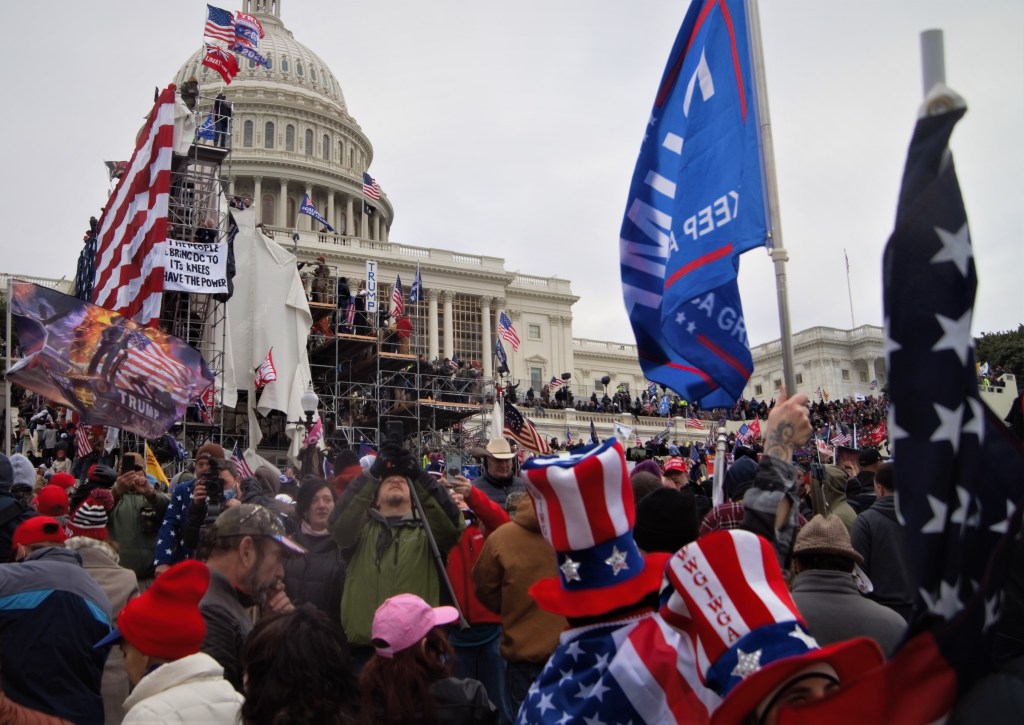
On January 6th, 2021, Americans witnessed a deplorable spectacle of mob justice as hundreds of citizens surrounded and stormed the Capitol to stop the certification of Joseph Biden to the United States presidency. Video footage from that day depicts a motley crew of individuals crowned in red MAGA hats or holding poles from which Gadsden and TRUMP 2020 flags were hung, while others outfitted in paramilitary equipment such as helmets and walkie-talkies brandished baseball bats or pepper spray canisters or megaphone speakers with which to goad the swelling crowds, all coming together to swiftly overpower a sparse and unprepared police force and break into the palace of American democracy.
Many of the invaders appeared to have been possessed by a combination of rage and glee; a palpable anger in their faces at what they sincerely believed to be a stolen election both sated and fed by elation over what ease they had stormed the capitol. Watching the footage, one wonders how many of them had heads filled with delusions of patriotic grandeur—did they really think they were going to “stop the steal” or arrest Mike Pence for treason? Or did they know their rage, however valid they perceived it to be, was ultimately an exercise in futility? One cannot fully know. What was clear on that day and remains clear at present is that the Capitol Hill riot was just the latest national display of a human principle so basic it scarcely needs mentioning: thoughts and beliefs lead to actions. What starts in the mind does not always stay in the mind; ideas have consequences. How we think as individuals—how we process facts, premises, opinions, and how we formulate beliefs and build conclusions—not only affect our lives, but the lives of many others for good or for ill in magnitudes great and small.
It is this truth that undergirds the fears of Americans when they hear of the growing influence of movements like QAnon—fears which the events of January 6th for many appeared to validate. Conspiracy theories often strike the rational listener as silly, but terrifying things can happen when what sounds silly or absurd is taken with seriousness. And the more there are people who take such things seriously, the greater the terror that spreads. That is reason enough for us to labor for a correct understanding of QAnon’s spread within evangelicalism and political conservatism and to discern its implications for our nation as whole.
Diagnosing the Diagnosis
Not too long ago, Christianity Today posted an article detailing a report by the American Enterprise Institute which claimed that a little more than 1 out of 4 evangelicals believe the QAnon conspiracy that former President Trump is “is secretly battling a cabal of pedophile Democrats,” while around half of evangelicals believe that Antifa was behind the January 6th storming of the capital. The article goes on to say: “According to Daniel Cox, director of AEI’s Survey Center on American Life, the report suggests conspiracy theories enjoy a surprising amount of support in general, but white evangelicals appear to be particularly primed to embrace them.”
That last statement deserves our attention. The insinuation here is that white evangelicals—and as the article later makes clear, “white evangelicals” means politically conservative evangelicals— are a particularly gullible sort; that is, for one reason or another, they possess a dearth in reasoning capabilities in excess of most Americans that lend themselves to being duped on average more than other segments of the population. Basically, it’s a nuanced way of saying conservative evangelicals are more likely to be stupid.
Of course, to really assess the gravity of that statement one needs to ask, who else is particularly primed to embrace conspiracy theories? Or, to put it another way, if as the article suggests, white evangelicals are primed to embrace falsehoods, what exactly are those things priming them, and are those things lacking in other segments of the American populace? In other words, is this purported inclination towards fake news and outlandish theories which produce hysteria and outrage a disease of conservative evangelicalism, or American society as a whole? Notice what concluding the latter answer is correct does not imply: if true, it does not imply that evangelicalism does not have a problem that needs solving, it just implies that if they do have a problem in need of a solution, it is a jointly-held problem affecting more than just themselves.
This is important to note for two reasons. First, as outlined in the last post, Many of those sounding the alarm of QAnon’s spread are conservative evangelicalism’s critics and foes. This raises the question of why the alarm is being sounded. Surely it is not out of compassionate concern, as if those on the left are troubled that their ideological opponents are falling prey to misinformation and poor reasoning—they already think evangelicals are dolts and would surmise as much whether or not QAnon ever came into existence. No, much ado is being made over QAnon in large part because of its implications the left find readily available to aim and deploy against evangelicals. QAnon provides easy fodder for the left to say: “See? We told you: look at all those Jesus signs being waved alongside American flags in the storming of the capitol! Evangelicals are dumb, weird, and irrational; and their irrationality makes them dangerous.” In other words, evangelicals believe crazy ideas, which in turn makes them do crazy things.
Establishing a narrative in which your ideological opponents are (twirling pointer finger at the head) cuckoo is a very helpful tool in being able to dismiss anything they say that runs contrary to your ideological beliefs or political priorities—and perhaps more importantly, getting others to do so as well. You don’t have to do the hard work of subjecting their statements and arguments to critical analysis (which may of course prove your opinions and propositions to be the rationally inferior) and you keep others from engaging in that same reasoning process as well, which may lead to them leaving your side and joining the other.
Thus it must be understood that those who loathe conservative evangelicalism, or all political conservatives for that matter, have a lot of motivation in framing QAnon as a distinctly conservative problem, which of course, in one sense, it is. And it would be wrong to say that such a narrative is being merely constructed but not believed by many of those who speak it—as stated earlier, there are many Americans who are genuinely afraid of QAnon adherents and a portion of our citizens really do think evangelicals are crazy and a palpable threat to modern society.
But if indeed QAnon is merely a symptom of a sickness infecting a much wider swath of Americans, then it still holds that progressives and left-leaning individuals have a vested interest in making sure that such an understanding does not become the dominant mode of comprehending the spread of QAnon, as that type of understanding significantly diminishes the power of the narrative they are trying to construct.
There is a reason that children’s literature and films of yesteryear had bullies pronouncing kids with braces as “metal mouths” or “railroad faces,” while such portrayals would seem thoroughly trite and unrealistic today. Back then, there was that one kid who had them; now it’s not unusual to have multiple children in any given classroom donning orthodontic correctives. Since bullies work by isolating an individual from the group, and the easiest way to do that is usually by ridiculing them for something in which they are truly unique, orthodontics no longer functions well as bully fodder, since bullying works by highlighting an exclusive difference in an individual as a means of convincing others that he or she should be ostracized from the group. In other words, it’s hard to make a freak of someone when the class president, your best friend, and the girl you like all have glimmering, metallic smiles. In a similar vein, the narrative power of QAnon only works for the left if it is seen exclusively as a pathology of the conservative right. If it is something else, something more diffuse, then the rhetorical wallop of look-at-those-crazy-right-wingers goes out the door.
So we need to understand that there are highly motivating reasons in our current landscape of ideological warfare for framing the QAnon problem narrowly. And of course, if it is not a narrow problem, then those within media, government, higher education, and so forth that treat it as such do so for the expedience of short-term gain at the expense of the longer term health of our society. Those of us who are committed to bettering our society in the long run must resist such attempts whether we fall more to the right or the left in our political convictions. We must have an accurate understanding of what is fueling movements like QAnon so that we can excise the infirm elements that give rise to it from our midst.
But as stated earlier, viewing QAnon through a broad lens is not an invitation to view evangelicalism as possessing a clean bill of health. It is right and reasonable on the one hand for conservatism’s defenders to pushback against a narrative dishonestly tailored in a narrow way to lambast their movement, but in so doing they must still own up to any real problems within their ranks, otherwise, they are no better than their detractors. By denying any problems, they too would be peddling a dishonest narrative for the sake of partisan warfare, claiming to possess a level of intellectual and ideological health within in their movement higher than it actually is for the sake of projecting strength and moral superiority against their enemies. But whatever you deny having you will find yourself hard to be rid of.
Returning to our original line of inquiry, are conservative evangelicals a particularly gullible sort among the American populace? If the answer to that is yes, then understanding the spread of QAnon within its midst is fairly easy. It would be to no one’s shock to hear that those most predisposed to being deceived have become deceived by society’s latest tall tale or mass deception. It would be like telling a doctor that an obese, geriatric, and immuno-compromised man died after getting COVID-19, while his Spartan-fit grandson of twenty-two didn’t even need to check in to the hospital; the doctor is not going to be surprised. But if the answer is no, then the question of why exactly QAnon is spreading in conservative circles and what that means for the rest of the country needs to be answered.
Echoes in a Intellectual Desert
Perhaps the simplest way to get to the bottom of these things is to examine the reasons journalists and other thinkers themselves have proffered for QAnon’s spread in evangelicalism; from there we can see what implications might rightfully be drawn.
In his recent piece entitled “The Wasting of the Evangelical Mind,” The New Yorker editor Michael Luo blames what he believes to be a long-running streak of anti-intellectualism in American evangelical culture. He writes: “The style of the most popular and influential pastors tend to correlate with shallowness: charisma trumps expertise; scientific authority is often viewed with suspicion. So it is of little surprise that American evangelicals have become vulnerable to demagoguery and misinformation.” Luo bolsters his assessment in large part by referring to the work of Mark Noll, whose seminal book The Scandal of the Evangelical Mind published in 1994 (the title of Luo’s piece is a riff on the book’s title) famously opined, “The scandal of the evangelical mind is there is not much of an evangelical mind.” Noll’s contention, in part, was that Evangelicalism, as the successor movement to the fundamentalists of the early twentieth century, inherited from fundamentalism its deep distrust and opposition to modern intellectual thought.
Fundamentalism, for those needing a refresher, was a reaction to the liberalism and skepticism that began to take root in the late stages of the nineteenth century, in which many people began to deny the authority and trustworthiness of the scriptures on the basis of science and other post-enlightenment modes of thinking which (supposedly) rendered such events as a literal virgin birth for Jesus untenable for those wishing to walk in the light of scientific truth while maintaining some form of faith practice. Fundamentalists refused to capitulate to the revisions of faith and doctrine modern academic thought allegedly demanded as an inexorable necessity. Their refusal was right of course; not because science and reason are incompatible with faith, rather it is the case that not all that masquerades under the banner of science or reason is really either of those things, as the ghastly horrors of the twentieth century would so ably point out. Nor does it follow that correct premises will invariably lead to correct conclusions, and as it is now, it was then, that there is no shortage of individuals who will bring correct premises to faulty conclusions and then berate those who reject their conclusions as being “anti-science” or backward or whatever.
Nevertheless, the contention is made that fundamentalists went too far in that they allowed their disdain of modern academia to transform into contempt for the intellectual life itself. Whether or not such characterization is accurate is beyond the scope of this essay; the point is Noll believes this anti-intellectualism has become the cultural norm of evangelicalism, and Luo agrees with him.
Nor is he the only one to view anti-intellectual tendencies as evangelicalism’s bane. Ed Stetzer, Missiologist and contributing editor of Christianity Today, concludes his 2020 op-ed in USA Today about the rise of QAnon in evangelicalism by also invoking Noll’s work, stating: “If there is anything that represents the scandal of the evangelical mind right now, it’s the gullibility of Christians who need to be discipled into critical thinking about how to engage the world around them. We need to be able to see through the bias and discern conspiracy theories that have risen to the level of messianic religion.”
Stetzer’s use of the words “critical thinking” is key here. It is the purported inability or unwillingness to think critically that dogs evangelicals and lies at the heart of QAnon’s spread. Stetzer is not saying evangelicals need to brush up on their Derrida or Weber or what have you, as if their minds required a fresh coat of academic pretentiousness, rather he fears evangelicals lack the tools of thought necessary to effectively “engage the world around them.” Perhaps Luo would agree, though for him critical thinking would involve or would inevitably lead to consulting those of “expertise” and “scientific authority.” That sentiment of course could lead us on an entirely different trail of examining what exactly is meant by “expertise,” since anyone of real acumen would be able to discern that a substantial portion of evangelical ambivalence towards the “experts” has much to do with disagreement over what constitutes one rather than the loathing of a category of people as such. After all, the conflation of ideology with expertise is endemic within circles of higher education today, and many denouncements of ordinary citizens rejecting “the experts” come from priggish elite educators affronted by the fact that a portion of the populace does not consider their Ph.D. in History or Sociology the indisputable grounds by which they must accede to their Marxist beliefs. But to what extent evangelical mistrust of our culture’s elites and their institutions is valid is beyond our present scope.
In addition to the anti-intellectualism and or lack of critical thinking offered as a possible source of evangelicalism’s flirtations with conspiracy theory, we have the echo chamber proposed as well. Returning to the CT article, we are told:
Asked to explain why white evangelicals appear disproportionately likely to embrace conspiracy theories, Cox noted that, as a group, they do not fit a stereotype of conspiracy theorists as people disconnected from social interaction. Instead, most retain strong connections to various social groups.
But white evangelicals stand out in a different way: The vast majority say some or a lot of their family members (81%) or friends (82%) voted for Trump in the 2020 election—more than any other religious group.
“People who do strongly believe in these things are not more disconnected—they are more politically segregated,” Cox said.
The resulting social echo chamber, he argued, allows conspiracy theories to spread unchecked.”
So, it is evangelicals’ purported political homogeneity, their lack of cross-pollinating political discourse, ideological incest if you will, that is partly to blame for QAnon’s rise.
A Disease in Common
Taken together, the two maladies would seem to be a very hazardous mix. Shallow-minded, unthinking individuals clustered together without intrusion, eagerly promulgating and reinforcing misinformation alongside shoddy rationales to one another is not bound to produce anything good. Now, setting aside the question of whether these two ills actually plague evangelicalism, let us assume for the moment that they do. The question then becomes, are these two qualities rare to the broader American populace? The answer, of course, is no. The echo chamber and uncritical thinking are by no means the exclusive domain of conservative evangelicals. They are, on the contrary, rapidly becoming hallmarks of our entire society.
Much has been said over the past twenty years of American’s increasing polarization, what Bill Bishop pithily coined back in 2004 as “the Big Sort;” more and more individuals of like-minded politics are clustering together in a form of self-segregation that is playing out geographically at both the intra-state and inter-state level. The coasts are blue and the middle of the country is red; a state’s urban areas vote democratic and its rural areas vote republican with the suburbs tending to lean one way or the other. Increasingly rare are those members of our Union deemed “purple states,” and it can be argued that even a state’s purple status in many cases belies its own polarization: if a state is made up of a confection of solidly blue and red counties, i.e. if the individual communities that make up the state are not themselves purple, is it really a state resisting the forces of polarization?
Additionally, the advent of the Internet has accelerated our descent into the echo chamber, the algorithms of social media and YouTube designed to give us more of what we like so that we are subjected to an ever-growing barrage of voices affirming and reinforcing our political views while opposing viewpoints and voices are shut out from our “suggested videos” playlist—not that we’d be open-minded enough listen to them if they came up anyway. And one only needs to take to Twitter to know that authentic dialogue between differing parties and genuine political curiosity are, like the California Condor, endangered American species.
One could go on with an ever-expanding list of examples of our nation’s polarizing tendencies, but the point is, to anyone paying any attention, it is self-evidently not a distinctively conservative phenomenon.
And what of the lack of critical thinking and anti-intellectualism? A book’s worth of material would need to be written to adequately chronicle our nation’s wholesale intellectual decline. We have incessant reports every few years of our children’s plummeting test scores, the decline in reading skills or the ability to write a persuasive essay, an increasingly large list of countries that outperform us on math, science, engineering, and so on. The state of our civics education has long been woefully bad, with one out of every four Americans unable to name the three branches of government and over half of our citizens unable to name a single current justice on the supreme court. Our universities, which if anyone is being honest knows are progressive echo-chambers staffed with astronomically high percentages of professors identifying as left-leaning, are filled Gen Z’rs (the least likely of any generation to identify as conservative or evangelical by the way) who demand intellectual discussion be severely curtailed due to a seemingly ever-growing amount of viewpoints deemed too “traumatizing” to listen to. A dearth of critical thinking unfortunately is becoming as American as apple pie.
It makes much more sense then, (if we are to take the reasons given by those concerned by its rise) to view the spread of QAnon as previously stated as a particular symptom of a social disease infecting our entire body politic.
For anyone engaged in that ever-more-elusive activity of critical thinking, it would probably cross their mind to point out that if indeed QAnon is merely a particular symptom of a larger social ill, it follows that there should be other symptoms as well. That is to say, the question should be asked: where else then do we see manifestations of poor thinking working in tandem with an echo chamber? Several answers spring to mind, but for the sake of space, we will make mention of one: the spread of critical race theory.
Here we have a system of belief among progressives that mirrors QAnon in more ways than one might initially think. Both theories deal with nefarious forces that work their ills on the American populace secretly (albeit in different ways) contra to available evidence. For one the nefarious force is a group of “deep state” actors, satanic elites who are embedded in American institutions and secretly working for the nation’s destruction. For the other, it is an unconscious way of thinking (which of course cannot be empirically discovered or verified) that secretly weaves its way through institutions to produce systemic oppression against racial minorities.
Truth be told, the gullibility of those who believe in CRT is quite astonishing. To reduce the presence of unequal outcomes among various ethnic groups to one variable of analysis is patently asinine. Any sociologist worth his salt (and any man or woman with a modicum of common sense for that matter) knows that a variety of factors are at work in the formation of a particular demographic group’s situation relative to another one. Those that dogmatically claim that all inequality is a result of widespread racism cannot prove their claims and so have taken to declaring that demands for evidence themselves are racist, objectivity and rationality themselves now manifestations of pervasive “whiteness.”
Indeed, it is arguable that Critical Race Theory constitutes the greatest widespread threat to critical thinking (and irony considering its name) America has ever known. This is because it formulates an impenetrable worldview built around self-validating circular logic. Premise 1: everyone is racist. Premise 2: Any attempts to question or deny the premise that everyone is racist is a manifestation of racism. From these two premises, all attempts to reason with CRT adherents will only reinforce their worldview. Someone will ask: What proof do you have that everyone is racist? What about Nigerians or East Asians who are doing better than white people? By what form of analysis do you know unconscious bias is at work in that white person? All these are legitimate questions those who wish to undertake the search for truth will ask. But under the CRT worldview, those questions merely becoming confirmations of the inquirer’s racism. Once a person enters into CRT world it’s hard to get out.
Which is to say, it sounds like a bit of a cult. And indeed, those that have steeped themselves in “wokeness” have psychological similarities to those under cultic auspices, not least among them the tendency to think they know more than everyone else (they are “woke” while everyone else is sleeping) and to exhibit an overweening sense of superiority because of it. Consider this quote from cult expert Rachel Bernstein: “When people get involved in a movement, collectively, what they’re saying is they want to be connected to each other. They want to have exclusive access to secret information other people don’t have, information they believe the powers that be are keeping from the masses, because it makes them feel protected and empowered. They’re a step ahead of those in society who remain willfully blind. This creates feeling similar to a drug—it’s its own high.”
Do you have any friends that have gone “woke?” If you do, then you know how apt that statement is in describing them. For our woke friends, the “powers that be” have tried to keep secret through the “myth of meritocracy” and the lie of a colorblind society the reality of systemic racism through “whiteness.” The ones that can’t see it, are to their minds willfully blind, i.e. they are stubbornly holding on to their “privilege,” while as part of the “woke,” they are working together with others in a morally elite and enlightened group, engaging in “allyship” and “doing the work” of advancing equity, crusaders in the great moral cause of our day. The thrill of purpose in such people is self-evident—needing a cause has forever been a perennial desire of the human heart—as all too often is the thrill of feeling oneself to be morally superior, pride our king hamartia.
But here’s the kicker: the quote given above was not made in reference to CRT or wokeness; it is from an article in WIRED magazine made in reference to the QAnon movement. The author of the article, commenting on Bernstein’s quote cited earlier says: “This conviction largely inures members to correction, which is a problem for the fact-checking initiatives that platforms are focused on. When Facebook tried adding fact-checking to misinformation, researchers found, counterintuitively, that people doubled down and shared the article more when it was disputed. They don’t want you to know, readers claimed, alleging that Facebook was trying to censor controversial knowledge”(italics the author’s, not my own).
Basically, the author is pointing out that one of the ways cults work is by taking any opposition to their claims as proof of their veracity. For the QAnon adherent, labeling anything associated with the movement as misinformation is just the secret satanic cabal at work trying to discredit the information so they don’t get exposed. How, one should ask, is that any different from your woke true believer, who claims any attempts to use statistics or logical arguments to question critical race theory’s precepts are proof-positive of a person’s racism and an attempt to uphold an oppressive system? Answer: it’s not.
In CRT/wokeness you have the same elements of QAnon at work. You have a worldview in which observable reality belies actual reality, one where secret nefarious forces are at work and those who have been awakened to this truth are also initiates to a battle of near cosmic proportions. A global cabal of elites serves as the enemy in one worldview, systemic racism in the other. Additionally, both sets of adherents are likely to have been predisposed to their beliefs to some extent through geographic polarization and the echo chambers of the internet and social media, and both have fallen prey to a state of mind that disrupts their ability to think with rationality and intelligence.
To clarify: this is not an attempt to make an absolute equivocation between the two movements. Each exhibits distinct and important differences, which we may delve into at a later time. But as two separate and distinct movements they are nonetheless connected like offshoots from a common branch, both springing from a lack of thinking and a proclivity to being duped that is evident in millions of people all across the political spectrum and only growing larger. The dangers from this impoverishing of the mind are manifold and will only increase in number in the days ahead, and those who care about our society must be willing to fight them wherever they see it whether in conservative or progressive circles.
In that sense then, the right level of analysis for QAnon—that is to say, the one that is truly helpful—is one that goes beyond partisan contempt into a holistic assessment of our populace. After all, a doctor who treats symptoms before he or she has ascertained the cause can prove to be a deadly one. To prescribe pain killers for a patient with reoccurring headaches may seem to be the reasonable thing to do, but if that patient has headaches because of a tumor in their brain, then the doctor’s focus on symptom-treatment to the detriment of discovering what the headaches are symptoms of becomes a form of cruel and negligent medical malpractice. So it is that left-leaning citizens and progressive politicians harping on about the dangers of QAnon for political gain, partisan anger, and self-righteous posturing do incalculable harm to the country they claim to care about.
This leads us to one final question: how come so many of conservative evangelicalism’s critics do not see the spread of QAnon from this higher plane of thought? The answer: because they themselves exhibit in various degrees the very same qualities that helped give rise to the QAnon movement they so vehemently denounce. Many of the people sounding the alarm over QAnon are the very same ones shrugging their shoulders over the spread of CRT. Their brains turned off, they think CRT is just the latest right-wing bogey-man despite the fact that unlike a host of other polarizing issues, this issue is stirring up intense concern among many prominent thinkers and journalists on the left, not just the right.
These are some of the ones who took to social media on January 6th to voice their indignant outrage and horror over the sick spectacle that was the Capitol Hill riot and yet were the same people blithely tweeting and reposting quotes six months earlier of MLK saying “riots are the language of the unheard” as stores were looted, businesses were burned, and people were gunned down. They are the victims of their own echo chambers and their inability to reason beyond the partisan narrative to which their thoughts have long been shaped. They cannot see that what plagues a segment of those evangelicals and conservatives whom they so abhor plagues them too in their own way.
To hearken back to Noll, there may indeed be a “scandal of the evangelical mind,” of which the acceptance of QAnon among some evangelicals is its latest vice. But the larger scandal, of which admittedly this essay has only faintly sketched, may be the scandal of the American mind; a scandal which reaches from the ocean blue coasts to the deep red South and back again. Clear-headed thinking is in much shorter supply among the American populace than many realize; how much shorter and how much detriment we will reap from this lack remains to be fully seen. One thing that is clear, however, is that situation appears to be getting worse, and as we stated at the beginning, thoughts and beliefs lead to actions. In a country of worsening minds, then, we should expect to see a worsening of behavior by our citizens, a worsening of decisions made by our leaders, and a worsening quality of shared life as our problems compound and viable solutions to them light up in less and less minds while simultaneously being discarded by a growing number of minds that consider then reject them. Eventually, that will lead us far from the domain of scandal and into the much worse one of tragedy.

*By Tyler Merbler from USA – DSC09265-2, CC BY 2.0, https://commons.wikimedia.org/w/index.php?curid=98724490
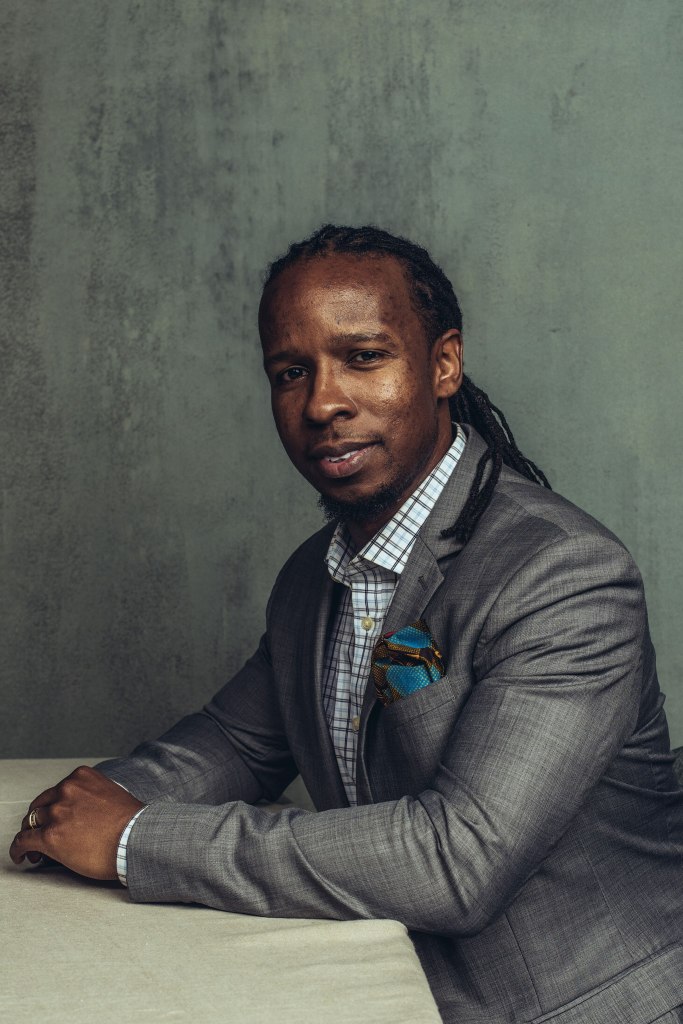
**Oregon State University, CC BY-SA 2.0 https://creativecommons.org/licenses/by-sa/2.0, via Wikimedia Commons



 Paths of Righteousness